


News
-
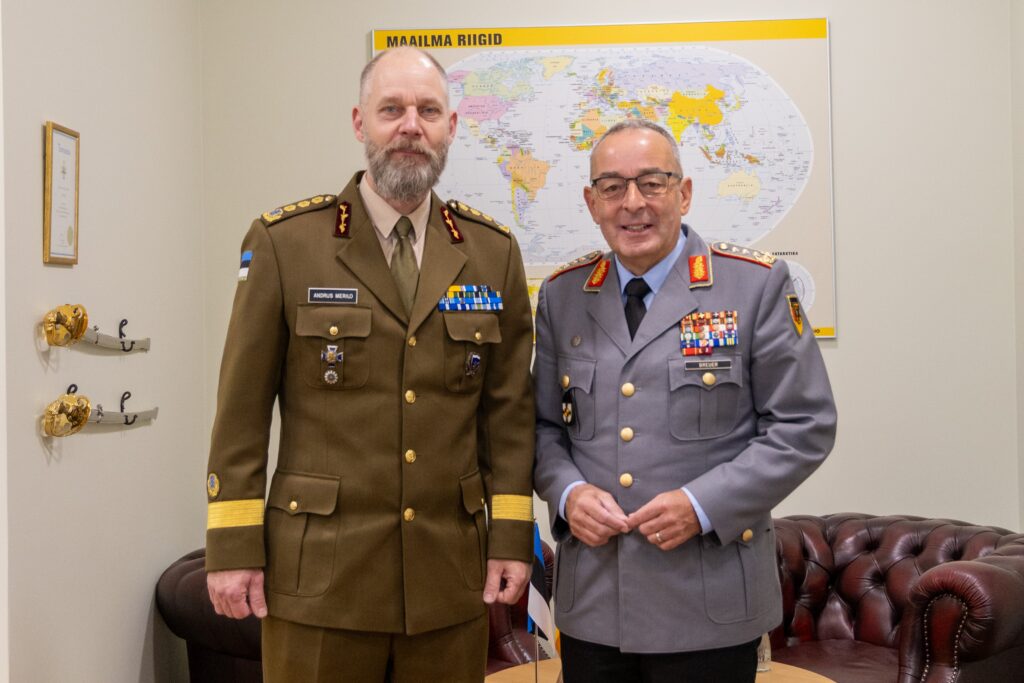
DSACEUR discusses strengthened readiness measures in Tallinn
As a part of these measures, NATO has deployed standing maritime forces to the Baltic Sea and to the Eastern Mediterranean.
An Estonian Mine Countermeasures Ship, the ENS Admiral Cowan, recently joined one of NATO’s Standing NATO Mine Countermeasures Groups. The ships are in the Baltic Sea as a part of NATO’s increased presence in the region.
"Estonia is playing a key role as part of NATO’s collective response capability during times of increased tension by providing the ENS Admiral Cowan to our Standing Maritime Group which is currently in the Baltic Sea,” said General Bradshaw.The Alliance is also increasing its presence in the air over Eastern Europe, and will augment its air defences on the ground, and conduct additional exercises in the territories of Eastern Allies.During the next rotation of the Baltic Air Policing Mission starting 1 May 2014, the number of aircraft stationed in the Baltic member states of the Alliance will increase to twelve fighters from the usual four."Amari Air Base in Estonia will play a key role in NATO’s expanded air policing efforts,” said General Bradshaw. "Danish F-16 fighter aircraft stationed in Estonia, will send a clear message that NATO is prepared to meet and deter any threat to the Alliance,” he said.Poland will also provide four MiG-29 aircraft and the United Kingdom will contribute four Typhoons, which will be stationed in Šiauliai, Lithuania."Estonia is a strong Ally and your continuing commitment to the Alliance, and especially our mission in Afghanistan has been exemplary,” he said. -
Ukraine’s wake-up call for NATO
For years leaders of this Baltic state were an irritant at NATO meetings, insisting to eye-rolling ambassadors from Western Europe that Vladimir Putin’s Russia was a revanchist power bent on destabilizing and dominating its neighbors. Now they voice grim satisfaction that what was once dismissed as paranoia has become the West’s conventional wisdom.
But the satisfaction has its limits. “The thing about being a Cassandra, being right is not necessarily great,” President Toomas Ilves told a security conference here over the weekend. “Because if you have read your ‘Iliad,’ you know she dies.”
Estonia and the two other Baltic republics swallowed by the Soviet Union in 1940 are a good place to see how the Ukraine crisis is transforming what for two decades has been the “post-Cold War order” in Europe. Suddenly the Baltic countries are not tiny backwaters, but “frontline states” on a continent once again dominated by a standoff between Moscow and the democratic West.
A company of U.S. 173rd Airborne Brigade soldiers is flying into Tallinn Monday, part of a deployment of 600 U.S. troops in Poland and the Baltic states. F-16s from Denmark are due Wednesday at an airfield newly designated as a NATO facility. In Brussels, NATO is debating whether to make the deployment of troops and planes to the region permanent, thereby scrapping a 1997 pledge to Russia not to station forces in the central and Eastern European countries that joined the alliance after the Soviet Union’s collapse.
A threat that once was dismissed as imaginary now looks all too real here. Like Ukraine, Estonia and Latvia have large Russian-speaking populations, concentrated in areas close to the Russian border. Both countries have been accused by Moscow of mistreating this minority. In 2007, Estonia’s removal of a Soviet monument led first to rioting by Russian speakers and then to what appeared to be a massive, Moscow-sponsored cyberattack.
In theory, the Baltics should be invulnerable to the unconventional, quasi-covert war Russia has launched against Ukraine because they are members of NATO. But pessimists here worry that alliance membership might also make the Baltics a tempting target for Putin, should he succeed in dismantling Ukraine. Were the “little green men” of Russian special forces to appear, say, in Narva — a town close to the border where less than half of the population of 65,000 holds Estonian citizenship — might NATO struggle, as it does now, to agree on a response?
“NATO cannot afford the Crimea or east Ukraine scenario in any town or any border of any member state,” Estonian Prime Minister Taavi Roivas told me. “That would be the end of NATO.” It’s probable that Putin has had the same thought.
How to stop this very 21st-century model of aggression, with its mix of propaganda, cyberattacks, special forces and troops massed on the border? The Estonians say they’ve learned some lessons from Ukraine and from their own history. The first is: Don’t hesitate to fight back.
“If the first green man appears in Narva, the government knows exactly how to respond,” Maj. Gen. Riho Terras told the Lennart Meri security conference. “You have to shoot the first green man, and the second will not come.”
Actually it is not that simple, as Terras himself quickly acknowledged. There is the problem of fending off the cyberattacks that might accompany disturbances in a Russian-populated area, as well as the concentrated propaganda on Russian television channels. Estonia has made itself NATO’s cyberdefense maven since 2007, but neither it nor Latvia has a local, Russian-language TV channel, even though a quarter of the population in Estonia and a third in Latvia are Russian-speaking.Then there is the threat of troops on the border. In 2009 and again last year, Russia staged major exercises simulating an invasion of the Baltic states by more than 20,000 troops. That’s more than the combined armies of the three countries, which also possess no tanks or fighter planes. Said Terras: “I am absolutely sure that we need heavy armor capability. Russia understands heavy metal and power. Power is not cyber. Power is tanks.”
The chances that Estonia will get that deterrent, either on its own or by a NATO deployment, don’t look particularly good. In Brussels, Germany, France and Italy are among the governments lined up against a permanent NATO deployment in the Baltics; a frustrated Eastern European ambassador dubbed them the “white-flag coalition.” The Obama administration deployed the paratroopers as a non-NATO operation and said they will stay through 2014. But U.S. ambassador to NATO Douglas Lute said here that it was “too soon to tell” whether a longer-term deployment would be needed.
As usual, the Estonians find themselves well ahead of their allies. “The events in Ukraine were a powerful wake-up call for part of the international community,” said Defense Minister Sven Mikser. “But the Baltic countries didn’t need any waking up.”
-
Veterans have much to give the community
Almost twenty years ago – 1995 – the first Estonian troops were deployed on a mission to Croatia. At the time few thought that in the next twenty years we would be sending our soldiers to the most difficult war zones.
Today over 2500 men and women have participated in operations abroad. This is a force to be reckoned with - Estonian veterans are among us at work, are fellow students, are in the community were we live and among our friends, who we communicate with.
With the Afghanistan operation coming to an end, Estonia has promised to contribute to operations where international assistance is needed - conflicts will not disappear from the world.
Every year we add new veterans to our ranks with their own joys and worries. Last year we adopted our veterans policy which guarantees that society recognizes individuals who have with gun in hand, fought for Estonia, been wounded, and lost their lives. Veterans will remain with us for many years - war experienced officers, non-commissioned officers, reservists as well as the war wounded.
The nation of Estonia spends two percent of its Gross Domestic Product fo military. The contribution of veterans is significantly bigger - with some unfortunately 100 percent. National securities, opportunity to apply for a Kredex guaranteed loan, attain a higher education, receive an additional percentage with your pension - there is hands-on national assistance to all that have fought for Estonia.
Evolving support system
Our nation has already done much to ensure that injured Defence Forces members can manage well in life. We still have a lot to accomplish - the development of support systems is only at a beginning phase. Injured Defence Forces members are generally young and strong men-women, who have still much to accomplish in life - their injuries should not scare or keep them away from society.
They can currently receive high quality prostheses, attend rehabilitation treatment in England, the Defence Forces guarantees them a job. We try to assist injured warriors by finding suitable athletic activities. Two severely wounded veterans- Master Sergeant Egberd Erreline and Sergeant Ott Jõesaar are good examples how one can continue in the service, they have even been on international operations after their injuries.
Yet, the majority of wounded veterans admit that the most important recognition is a good word from fellow citizens and society. Veterans have much to contribute to society - the cornflower campaign, initiated by the Wounded Warriors Association, uses donations to purchase walking robots at East Central Tallinn hospital for injured soldiers. All Estonians, not only the war wounded can use these assistance systems.
We can all contribute by buying a cornflower. With assistance from the United States we are about to create a rehabilitation centre for all prosthesis users. A future master technician in prosthetics is a fellow war amputee, who knows very well the worries of injured individuals.
The life and work experiences of veterans make them decision making leaders, good co-workers and teachers. Our Allies have valued the deliberation of our soldiers as well their ability to understand the situation of the peoples in Iraq and Afghanistan. I believe that for any employer they are able bodied, decision capable emphatic employees, whom we can rely on.
As a small nation, it is imperative that Estonia is taken as an equal partner. We must show that we are able take responsibilities and fulfill them. As a nation whose security is reliant very much on the effective operations of NATO, it is important that the Allied nations are able to jointly act, plan and carry out operations. In light of the events in Ukraine we have had confirmation that the Estonian Defence Forces is an equal partner - we discuss openly with the other Chiefs of Defence of our Allies about events taking place in the world and if necessary, can ask for support and assistance, being ready at the same to support them as well.
Invaluable skills
We would never have dreamed of such a trusting relationship had it not been for the contribution of our Defence Forces members who served with our Allies. The current Commanders of the large nation armies commanded units in Afghanistan and Iraq where our soldiers belonged a few years ago - our soldiers are remembered.
In preparation to defend Estonia it is imperative that soldiers are able to make correct decisions in combat and carry them through. You can study that for tens of years but until you have experienced combat and made decisions, you can never be sure that you would be competent in such an extreme situation. These types of experiences have been received by many in Iraq and Afghanistan. Those that continue their service, pass on their experience to others. We know that for those that have left the service, we now have combat experienced reservists.
To have a high combat readiness it is necessary to have discipline and battle preparedness as well as knowledge of in what name are we fighting, it is equally important for soldiers in a small unit with whom you are shoulder to shoulder together in the fight as well as in society who you are fighting for. The respect of society is necessary for veterans; they appreciate your support and give back their efforts so that our nation would survive.
Last year Veterans Day events received a warm welcome from the members of the Defence Forces as well as the general public, our parliament is weighing on declaring the day an official national holiday. Raise the flags now for Veterans Day and support in word and in action the veterans that have fought for Estonian independence.
-
NATO and U.S. European Command representatives meet in Estonia
According to Commander JFC Brunssum, General Hans-Lothar Domröse, it´s important that his headquarters acts as a hub for bringing together all the Northern region headquarters to make necessary adjustments to existing threat assessments, especially in the wake of recent events in Europe.
“We have established a very good personal relationship to assess the situation together and form a common view on this. While the conference is regular in its nature, recent events do have an impact on our work,” General Domröse stressed.
“Our threat perception has changed and we have to evaluate whether current counter-measures are sufficient. Our job here is to formulate recommendations that can be passed to SHAPE and representatives of NATO member nations so that future capability decisions are the result of informed consideration,” Deputy Chief of Staff for Plans JFC Brunssum, Major General Hans van Griensven, added.
Baltic Spring is an annual conference that offers a venue for NATO commands, including SHAPE, Maritime, Air, Land, Special Forces command, STRIKEFORNATO, U.S. European Command (EUCOM) and Armed Forces´ representatives from Poland, Estonia, Latvia, Lithuania, Norway and the Partner Nations Finland and Sweden, to discuss regional security issues, exchange views and raise situational awareness. The conference also aims at fostering interoperability between NATO and Baltic nations and provides a platform for sustained, long-term, and enduring NATO commitment to the Baltic region.
“The event is part of our regional focus, but it´s important to recognise that we are already doing several activities in the region, such as the JFC Brunssum certification exercise Steadfast Jazz last year, using an Article V scenario. That´s already an assurance that we are taking things seriously,” ACOS J5 at JFC Brunssum, Brigadier General Torgeir Gråtrud, commented.
During the academic session the attendees received overviews on Baltic history and NATO relations with the UN, Russia and the pretext Russian Federation used in the Crimea intervention. Dr. Brooke Windsor-Smith, a researcher at NATO Defence College, highlighted that President Putin´s recent actions are making collective defence more relevant to the Alliance than it has been in recent years. “It is very likely that collective defence will now become the main narrative of the upcoming NATO summit to be held in Wales,” he added.
“For the past ten years the focus of NATO has been abroad - the reason being that there was no significant nearby threat perceived so the Alliance adopted a more expeditionary outlook. Because of recent events in Crimea and the Ukraine we have to consider the Article V threat as a real possibility again,” Major General van Griensven added when talking about the Alliance´s future challenges.
This year Baltic Spring was organised for the fourth time. In the autumn, the respective commands and headquarters meet at the staff officer level to discuss the detailed issues of military cooperation.
-
Exercise in Denmark centres on cooperation between Defence Forces and Estonian authorities
“We are currently used to planning operations and following through with them primarily in Afghanistan, where national infrastructure and the status of the authorities is significantly different from the NATO member nation,” said the Commander of the Danish Division, Major General Michael A. Lollesgaard, into whose division along with his two Danish brigades are included according to NATO structure, infantries from Estonia, Latvia and Lithuania. “As for Estonia we are dealing with a developed nation, which has a strong infrastructure and where the battleground does not belong to the military but rather to the government of the nation.”
The Estonian authorities participating in the exercise are tasked to create a situation for the Danish Division and Baltic Infantry Brigade staff, related to domestic concerns where a fictitious nation Bothnia has invaded Estonia´s capital Tallinn and part of Pärnu. Consequently NATO Article V has been activated.
Participating in the command post exercise along with the 1. Infantry Brigade staff are Estonian representatives from the Ministry of Defence, Ministry of Interior, Police and Border Guard Board, Rescue board as well as from the city government of Tallinn. From the Danish side representatives of the International Red Cross, Rescue Board, Water authority, Police as well as members of the local Defence League take part.
1. Infantry Brigade has been associated with the Danish Division since August 2009. The association is based on cooperation during exercises resulting in the ability of national staff and units to participate in joint operations.
-
Deputy Chairman, NATO Military Committee: We are prepared to take further steps
According to Schissler, NATO is ready to update the defence plans, enhance exercises and send appropriate deployments if necessary. “All Allies, including Estonia, are protected by Article 5 of the Washington Treaty. Our commitment to defend Allies is unbreakable,” he added.
The presence of NATO in the region centred the discussions today, while further development of the defence plans as well as issues of cyber defence were also at the table.
During the visit Lieutenant General Schissler also met with the Undersecretary for Defence Mikk Marran, visited NATO Cooperative Cyber Defence Centre of Excellence in Tallinn and Ämari airbase.
The Military Committee is the senior military authority in NATO and the oldest permanent body in NATO after the North Atlantic Council, both having been formed months after the Alliance came into being. It is the primary source of military advice to NATO’s civilian decision-making bodies – the North Atlantic Council and the Nuclear Planning Group.
Its advice is sought prior to any authorization for military action and, consequently represents an essential link between the political decision-making process and the military structure of NATO.
-
Commander of Defence Forces: Our deterrence is based on rapid response forces
While penning these lines, we do not know how the situation in Ukraine will develop. What we do know is that the Russian Federation aggression toward Ukraine is serious as well as that, for Estonia as a border nation for NATO and the European Union, everything must be done to ensure that similar circumstances do not occur in Estonia or in the region.
It is clear that the Ukrainian crisis was not created from scratch. In a situation where there are occurring several global security issues as well as determining processes, the Russian leaders have found a weak spot, figuratively a missing brick in the dam to fill the empty pouring security space with their forceful narratives and controlling powers.
What has in fact made the Russian federation act in this fashion, acutely in opposition to Europe as well as the Western world as a whole, creating and introducing their perception of international law?
Firstly, you cannot overlook the declining visibility of the United States in Europe, in foreign and security policy as well as in military terms.
Many were surprised by the U.S. low activity and the non-interference over the situation during the protests in the last months of 2013 in Ukraine, when important values such as human rights, democracy and national self-determination on the international arena were obviously at stake. These are values associated with U.S. foreign policy for decades.
Those who saw the signals in the above mentioned behaviour of the Russian Federation in the recognition of the so called sphere of influence were right. The situation has now changed so dramatically that the Allied security interests, always considered important by the U.S. have besides rhetoric forced the Alliance to apply assurance measures. The most prominent of these being the enforced Air Policing mission of the Baltic nations.
The European reaction to events in Ukraine has rightfully gained serious criticism. The methods by which Europe tried to call the Russian Federation to order have not been sufficient. This has confirmed the single most security and foreign policy’s greatest weakness - a lack of unity. This has brought about procrastination and a softening of the situation where actually more concrete and current political and economic methods should be applied faster and automatically as well as attempts at stopping the escalation of the crisis. This seeming feeling of security and protection has been present in Europe since the end of the Cold War.
The generation that currently is making decisions at the ballot boxes as well as at cabinet and parliament discussions, does not have a clear connection with the past or proactive threats from that era. The cashing in on so called peace dividends has become a trend so embedded that it would require a severe shock to be reversed. Is this what is actually happening as a result of the Ukraine? If you compare the situation in Georgia 2008 to a wakeup call that with a sleepy head was snoozed, the situation in Ukraine is the last chance to wake up because to keep on sleeping would have serious consequences.
Should Europe start seriously considering the events transpiring in Ukraine and undertake the necessary analysis, more importantly start to invest in security and defence, then the military-political adventure of the Russian Federation would be deemed a grave miscalculation whose repercussions would be hard to swallow and more complicated to digest.
How do Estonian national defence and the Defence Forces fit in this security environment? As stressed before, Estonian national defence has a strong connection with society. This comes from our national defence model, where two equal in worth necessary beams represent the primary individual defence capability as well as strong ties with our Allies, for collective defence. It is clear that in a situation where the vulnerability of society is in question it can become a key factor. In the event of a major crisis, how can we mobilize our entire forces enough to survive? How do we apply our broad-based national defence concept? These are issues that need to work on.
Our military deterrence is based on rapid response units. They must be well trained, equipped and armed accordingly to the corresponding assignments. To attain this goal it is important for all military personnel to be involved, but contribution from all the individuals involved in national defence is also needed. Only in then can we create a force that is strong and robust ie. creates deterrence.
The process began a few years ago for the Defence Forces with the new National Defence Development Plan. In addition to the everyday planning, participation in exercises and military operations there is a need to stress knowledge and development in national defence in general. The development of the Defence Forces is closely tied to the mental potential of the people. Innovation or the implementation of smart solutions in our work and activities are important for the future. To attain this, we must work together with the universities as well as with the developing defence industry.
Our long mission in Afghanistan is winding up in 2014. During this operation the Estonian Defence Forces have shown themselves in the best light. Thanks to our soldiers, non- commissioned officers and officers Estonia has remarkably strengthened its position in the international arena. Our word has more weight, we are reckoned with. It is apparent that Afghanistan will not be our last military mission far away from home. Last year we began participation in the Mali mission. Parliament has agreed to send our troops to the European Union military mission in the Central African Republic. All this refers to the fact that worries, crises and wars will not disappear from the world.
This in turn, requires us to maintain a constant readiness to act in any situation. 2013 was truly an exercise year. A large-scale NATO exercise Steadfast Jazz based its scenario on defending Estonia against the NATO article V attack. This demonstrates that our message has been received by our Allies. The main task of NATO is to support collective defence and to jointly train for that purpose. The events in Ukraine only confirm this truth.
In closing, I’d like to highlight our veterans. On April 23, 2013 we held our first national Veterans Day, which together with the implementation of our veterans policy must insure that our men and women who have stood armed in defence of our nation will be recognized by our society and they will be remembered. The cornflower emblem as a veterans support symbol has already found wide positive acceptance. The confirmation of Veterans Day as a national flag day is another good and thankful step in creating a strong bond between the Defence Forces and society at large.
-
EU Military Committee Chairman: Estonia’s dedication commits us to solidarity
According to Commander of Estonian Defence Forces, Major General Riho Terras the initiation of the mission in the Central African Republic is urgently needed to avoid a worsening of the situation. Estonia is prepared to deploy a platoon size unit along with support elements to the EUFOR RCA mission.
At the meeting, Major General Terras provided the European Union Military Committee Chairman with Estonia’s assessment on the current regional security situation and recent changes due to the situation in Ukraine. Impact on Russia from the current sanctions implemented by the European Union as well as possible changes in EU’s foreign and defence policy were also discussed.
According to de Rousiers he appreciates Estonia´s commitment to participate in missions in areas where Estonia has no historical links. “This commits us to display solidarity in situations where Estonia feels pressured,” he added.
General de Rousiers also met with the Minister of Defence, Sven Mikser; Undersecretary of Defence, Sven Sakkov and the Commandant Baltic Defence College, Major General Vaitalijuš Vaiksnoras.
The European Union Military Committee is the highest military body set up within the European Council. It directs all EU military activities and provides the Political and Security Committee with advice and recommendations on military matters.
The Committee is composed of the Chiefs of Defence of the Member States, who are regularly represented by their permanent Military Representatives.
Estonia is currently participating in the EU Training Mission in Mali with a training unit and staff officers, whose assignment along with other European armed forces is to train and advise the Mali Defence Forces. Estonia has previously participated in European Union mission Althea in Bosnia-Herzegovina and EUFOR Atalanta to deter, prevent and repress acts of piracy and armed robbery off the Somali coast.
Estonia will be contributing to the EU Nordic battle group next year. The Nordic battle group consisting of nearly 2000 members will be ready to deploy to European Union initiated operations in the first part of 2015. Estonia has been part of the Nordic Battle group along with Finland, Sweden, Norway and Ireland in 2008 and 2011. Latvia and Lithuania will be joining the battle group for the first time in 2015.
-
NATO Commander underlines importance of Article 5
Major General Terras stressed that the situation in Ukraine and Baltic Sea region has significantly changed, but it´s crucial to understand NATO Article 5 and the principle of collective defence only apply to Allied nations and not to Partner nations.
General Hans-Lothar Domröse assured that NATO works to protect all its Allies. “I have very close communications with Estonian authorities and we are constantly exchanging operational information. During my current 15 month command this is my fourth visit to Estonia,” he added.
General Domröse is currently in Estonia on a three-day visit and will be giving an overview of NATO´s core tasks, operational command and collective defence at the International Centre for Defence Studies in Tallinn and the University of Tartu, Centre for Baltic Studies. During his visit he is also scheduled to meet the Rector of the University of Tartu, Volli Kalm; Commandant of the Baltic Defence College, Major General Vitalijuš Vaiksnoras and visit NATO Cooperative Cyber Defence Centre of Excellence in Tallinn.
NATO JFC Brunssum, in the Netherlands, is one of two NATO joint force headquarters, the other being JFC Naples. The command is responsible for the long term planning of ISAF operation in Afghanistan as well as making preparations for the soon to begin NATO mission Resolute Support. Operational command of the NATO Response Force alternates between the joint force commands in Brunssum and Naples. In 2014 Brunssum is in command for NRF.
-
Commander of the Defence Forces: Poland is a true Ally
“Understanding of our region’s security situation as well as of the effects of the recent Ukrainian events, is very similar for Estonia and Poland. In that light, I am pleased to note that Poland is as a true Ally ready to contribute to the ensuring of security for Estonia, Latvia and Lithuania with its capabilities,” Major General Terras said.
In addition to the Commander of the Polish Defence Forces Terras also met with the Polish Defence and Foreign ministers and is scheduled to meet with the Polish Prime minister tomorrow.
Estonia and Poland share a long history of mutual understanding each other as Allies. Poland is one of the Baltic Defence College contributing countries. Estonian Special Forces train with Polish Special Forces units, Polish fighters have participated in the exercise Kevadtorm and have patrolled Baltic airspace. Last year, Poland hosted the tactical part of the exercise Steadfast Jazz, where NATO Allies trained defending Estonia from a foreign aggressor.